The choice between OEM and ODM is really a question about who owns the recipe. In OEM the brand brings the formula or the brief and the factory manufactures to it; in ODM the factory starts from compound knowledge it already holds and the brand adapts it. Everything else that follows, including speed to first order, how different the product feels, and how easily you can leave, comes from that single decision.
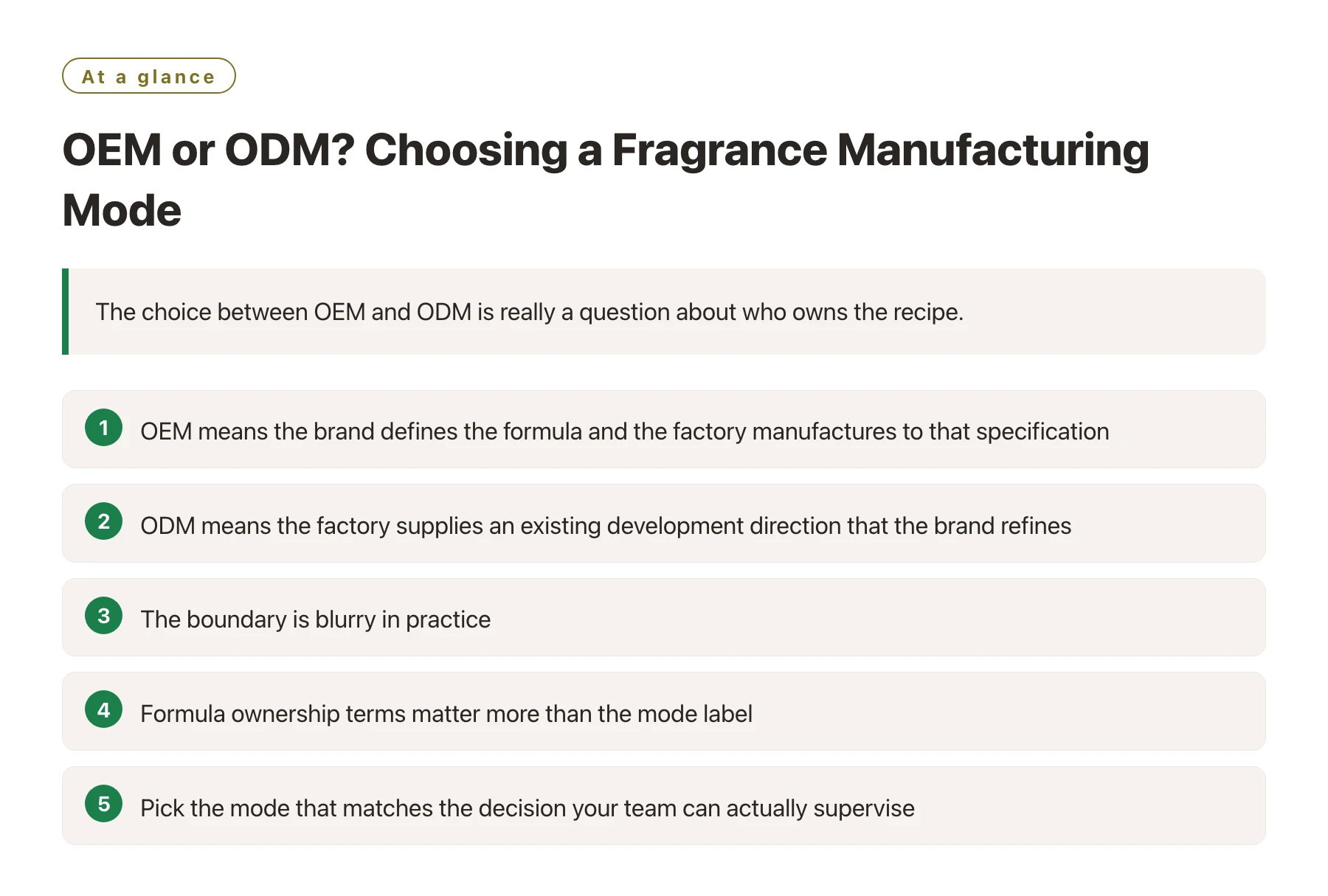
Key takeawaysOEM means the brand defines the formula and the factory manufactures to that specification, which protects differentiation but takes longer to develop. · ODM means the factory supplies an existing development direction that the brand refines, which is faster but carries a real risk of resemblance. · The boundary is blurry in practice, because most projects begin with the factory proposing directions even in a nominally OEM arrangement. · Formula ownership terms matter more than the mode label, since they decide exclusivity, portability and what you can take to another supplier. · Pick the mode that matches the decision your team can actually supervise, not the one that sounds more advanced.
Almost every fragrance manufacturer brochure offers OEM and ODM on the same page, and almost none of them explain where one ends and the other begins. Buyers are left comparing two words rather than two ways of working.
The practical difference is not about who is more capable. It is about where the creative and technical decisions are made, and therefore which risks stay with the brand. A project can be thoroughly OEM in contract and thoroughly ODM in daily practice, usually without anyone naming that shift out loud.
This breakdown treats the two modes as positions on a spectrum, then shows which questions force a clear answer before sampling begins.
The real difference is who owns the recipe
Strip away the labels and only three things change between the modes: who supplies the starting direction, who owns the resulting formula, and who carries the cost of getting it wrong. Any quotation that does not answer all three is describing a service, not a mode.
That is why the mode conversation belongs at the start of a project rather than at the contract stage. Once samples exist, the position is much harder to change, because the formula already belongs to somebody.
OEM: you specify, the factory produces
In a strict OEM arrangement the brand or its own perfumer defines the compound and the manufacturer reproduces it consistently at scale. The output is your formula, made to your specification, and the factory's contribution is process control rather than creativity.
This suits brands with a clear scent direction and a reason to keep it distinctive. The trade-off is time and cost: development runs through your brief, your sampling rounds and your approvals, and every iteration is a decision you have to make.
ODM: the factory starts, you refine
In ODM the manufacturer brings development directions drawn from work it has already done, and the brand selects and modifies. The compound houses that supply the wider industry, including large players such as Givaudan, describe their activity across several product segments rather than one narrow category [1], and that breadth is exactly what an ODM offer draws on.
Speed is the obvious benefit and resemblance is the obvious risk. A direction that already exists somewhere else can reach your market looking familiar, so the refining step is not optional if the product is meant to stand apart.
The line between them is blurry in practice
Most real projects sit in the middle. A factory proposes three directions, the brand picks one and asks for changes, and the finished formula is neither wholly yours nor wholly theirs. That is a perfectly workable arrangement as long as the ownership terms match what actually happened.
Five questions that settle the mode decision
- Who defines the starting point?If your team can describe the scent in technical terms, OEM is available; if not, you are buying a direction whatever the contract says.
- Does the scent have to be unique to you?Genuine differentiation usually requires an owned or exclusive formula, which points toward OEM or a tightly worded ODM exclusivity clause.
- How much development time can the calendar absorb?OEM sampling rounds take longer, so a fixed retail launch date can quietly decide the mode for you.
- Who can supervise the approvals?Every sampling round needs someone on the brand side to judge it, and a team without that capacity will slow an OEM project more than it slows an ODM one.
- What happens if you leave?Ask what you may take with you, in what form, and whether the factory may reuse the formula for another client in the same market.
The same project, seen through both modes
| Element | Lean OEM | Full ODM | Who owns the decision |
|---|---|---|---|
| Starting direction | Brand brief or brand-supplied formula | Factory proposal from existing development work | Brand, in both cases, at the selection step |
| Formula ownership | Usually the brand, if written that way | Usually the factory, with a licence to the brand | Contract wording, not the brochure |
| Time to first sample | Longer, because development starts from the brief | Shorter, because a direction already exists | Brand, through the speed of its feedback |
| Differentiation | High, provided the brief is specific | Depends entirely on how far the refining goes | Brand, at the refinement stage |
| Reformulation risk | Shared, since both sides know the formula | Mostly the factory, while the brand keeps the licence | Whoever holds the formula |
Read the last column as the one that matters most. Mode labels describe a commercial arrangement, but the daily reality of a project is a sequence of decisions, and the mode only helps if it tells you who is expected to make each one.
The most common mistake is choosing ODM to save time and then briefing it like OEM, asking for a heavily modified direction on a schedule built for an existing one. The result is an ODM price with an OEM timeline, and a formula whose ownership nobody clarified because the project started as one thing and behaved like another. Write the ownership position into the first document you sign, even if it is only a two-page letter of intent, and revisit it before the sampling rounds end.
Where the mode choice shows up months later
The consequences of this decision arrive quietly. They surface in a competitor's launch that smells similar, in a request to move production, or in a retailer asking who developed the scent.
None of those moments can be managed retroactively, which is why the mode question is worth ten minutes of attention at the very beginning.
Exclusivity is a clause, not a mode
An OEM project with no exclusivity wording can still produce a formula the factory is free to reuse, and an ODM project with a well-drafted exclusivity clause can keep a direction out of a competitor's hands for the agreed period. The clause does the work, so read it rather than assuming the label protects you.
Time to market is decided by feedback speed
Teams often assume OEM is slow and ODM is fast. In practice the pace is set by how quickly the brand evaluates and responds to each sample, and a decisive brand can move an OEM project faster than an indecisive one moves an ODM project. Trade coverage of beauty launches and regulation shows how frequently these plans are revisited [2], which is a reminder that a launch date is a moving target until the formula is locked.
Portability should be planned, not discovered
If there is any chance you will produce in another country later, ask now what the handover would include: formula documentation, approved reference samples, and the specific packaging drawings. Suppliers that run development, compounding and filling together, as Xuelei does from Guangzhou, usually have a defined handover file, and it is easier to request it before the first order than after the third. A practical comparison of both modes is set out on fragrance OEM/ODM services if you want the operational detail.
Sources
- Givaudan —— One of the largest fragrance and flavour houses; public material on fragrance creation, ingredient portfolio and market segments.
- Cosmetics Business —— A trade publication covering the beauty and cosmetics industry, including fragrance launches and regulatory developments.
Frequently asked questions
Is ODM cheaper than OEM for a first fragrance launch?
Usually yes at the development stage, because the starting direction already exists and fewer sampling rounds are needed. The gap narrows if the brand requests heavy modification, since that work starts to resemble custom development while the formula ownership may still sit with the factory.
Who owns the formula in an ODM project?
It depends entirely on the contract, not on the label. Many ODM arrangements keep ownership with the manufacturer and grant the brand a licence to sell the finished product. If exclusivity matters to you, ask for it in writing and check whether it is limited by market, category or time.
Can a brand switch from ODM to OEM later?
It can, but the transition is easier if it is planned. Ask what documentation, reference samples and packaging drawings you would receive on exit, and confirm that the formula you have been selling can legally be produced elsewhere before you commit to a second supplier.
Does OEM mean I need my own perfumer?
Not necessarily. Many brands work with an independent perfumer or brief the manufacturer's development team in technical terms without owning a laboratory. What OEM requires is that somebody on the brand side can define the target precisely and judge each sample consistently.
How do we decide which mode fits our team?
Ask who will evaluate each sample, how fast that person can respond, and whether the scent needs to be defensibly unique. Teams with limited development capacity usually do better with ODM plus a clear exclusivity clause than with an OEM process they cannot keep pace with.