Choosing Between Similar NSFW AI Characters
When two cards look alike, the tie-breakers are not the counters - they are the tags, the creator credit and a short trial on each. Run the test properly and it costs 20 messages: ten on card A, ten on card B, then keep one. At 540 messages a month that is under 4% of your volume spent settling a decision you would otherwise re-open every week.

Key takeaways
- Compare tags before prose. Cards sharing every tag are rarely as similar as they look once the creator credits are different.
- Use a ten-message trial per card, not a twenty-message trial: the first ten messages are where tone is decided, and 20 messages total settles both.
- Keep one and favourite it. Two half-used cards cost more attention than one kept card, and the favourite counter on the shelf is the record of your choice.
- View totals are the worst tie-breaker available: three cards read here sat within 1.34 times of each other in views while their keep rates differed twofold.
Why near-identical cards exist in the first place
Cards cluster because tags cluster. A tag decides who finds a card, so authors writing for the same tag tend to describe similar characters with similar vocabulary. On a shelf of 20 NSFW AI characters, several entries will carry the same combination - Unfiltered with a personality tag, for instance - and the surface similarity is a property of the tagging system rather than evidence that the cards are interchangeable.
What differs underneath is usually one of three things. The interaction style: some characters ask questions and some never do. The pace: some descriptions imply long scenes and some imply short exchanges. The voice: sentence length, formality and humour do more to separate two similar cards than any adjective in a tag row.
That is why the tie-break has to be behavioural. Textual comparison stops working exactly when the descriptions are most alike, because you are reading the same vocabulary twice and concluding sameness. A ten-message trial breaks that deadlock in a couple of minutes and answers the question the description could not.
A tie-break order that ends in a decision
Start with tags, one level deeper than the obvious match. Two cards both marked Unfiltered may differ on everything else, and the secondary tags tell you which one is aimed at the kind of session you had in mind. If the tag rows are genuinely identical, move on rather than re-reading the prose.
Second, compare creator credits. The card shows who made it as "by ...", and a creator whose earlier card suited you is the strongest cheap signal available. Two cards, same tags, different authors: take the author you already know unless the description clearly contradicts the earlier experience.
Third, compare descriptions on one criterion only: does each tell you how the character behaves in the second message? Whichever one does, that is the card to trial first. If both do, trial both, ten messages each, and stop at ten. The reason for the hard stop is that the first ten messages are diagnostic and the next ten are investment; if you carry on past ten on both cards you are running two conversations instead of making one choice.
| Tie-breaker | What you compare | Time cost |
|---|---|---|
| Secondary tags | Everything beyond the shared main tag | Under a minute |
| Creator credit | Whether either name is one you already know | Seconds |
| Behaviour in the description | Whether the second message is predictable | Two minutes for both cards |
| Short trial | Ten messages on each card, then stop | About five minutes each |
| Keep rate as a last resort | Favourites divided by views on each card | One minute |
Worked example: pricing a two-card trial at three intensities
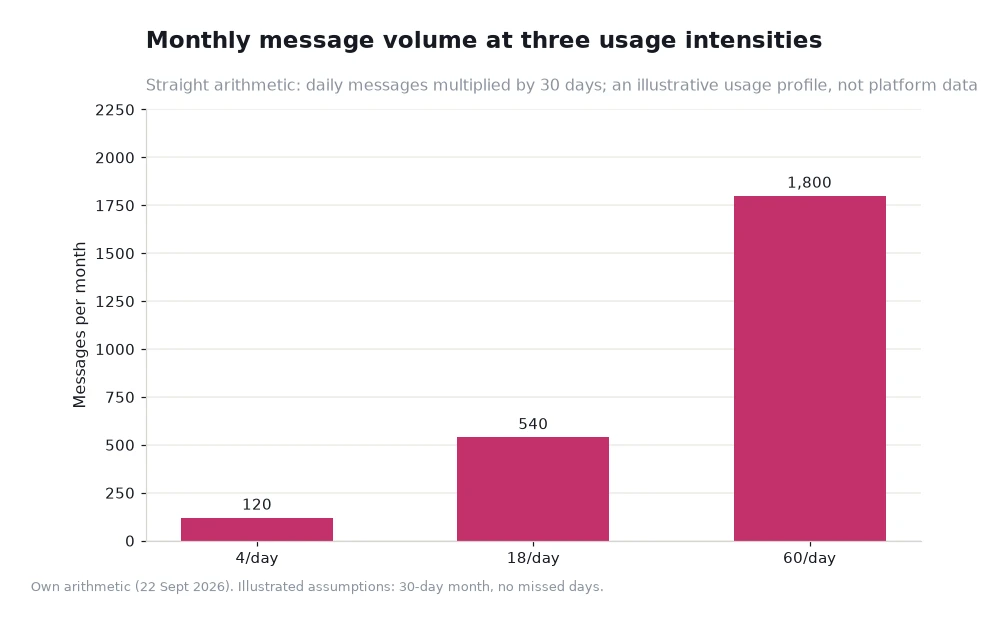
The trial has a fixed cost: 20 messages, ten per card, which is about ten minutes at 30 seconds a message with reading time on top. The chart below gives the three intensities to compare that against - daily messages multiplied by a 30-day month, so 4 a day is 120 messages, 18 a day is 540 and 60 a day is 1,800.
At the lightest intensity, 20 messages is 17% of a 120-message month, which is a significant share and a reason to run the trial only when the cards are genuinely close. At the middle intensity, 20 of 540 is 3.7%, which is trivial. At the heaviest, it is 1.1%, or roughly eight minutes of a month's writing time. The same decision, priced differently depending on how much you send.
That gives a rule rather than a preference: run the two-card comparison whenever it would cost under 5% of your monthly volume, and above that, decide on tags and creator credit alone. Every figure is an illustrated assumption, not a measurement from any account.
Keeping one and letting the other go
Finish the comparison on the same day, because a decision held open costs browsing time every week. Ten messages, ten messages, one card kept. Then favourite the winner: on this platform the favourite counter is a public tally, and using it as your own shortlist marker means your account records the choice you made rather than you having to remember it.
If neither trial convinces you, drop both and go back one level. That usually means the tag combination is wrong, not the cards, and the fastest fix is a different filter on the nsfw ai shelf rather than a third trial. Two failures on the same tag is a signal about the tag.
For a wider net than one shelf, the character search page lets you pull cards by tag without a ranking in the way, which is the better tool when you know what you want and only need the field widened. And if a card turns out to be a repeat of one you already keep, the the platform account page is where both entries sit side by side, which makes the duplicate obvious before you spend another twenty messages on it.
Frequently asked questions
How many messages should a comparison trial use?
Ten per card, so 20 in total. Tone is usually decided in the first ten messages, and stopping there keeps the second card from becoming a second commitment.
Which counter is the best tie-breaker?
The keep rate - favourites divided by views - and only as a last resort. View totals mislead most, because they mostly report position on the shelf.
What if both cards are disappointing?
Change the tag rather than trialling a third card. Two cards from the same tag that both miss is information about the tag, not about either card.
Ten messages each, one card kept
Set the order before you open anything: secondary tags, creator credit, behaviour in the description, then a ten-message trial each. Stop at ten. Keep one, favourite it, and let the other card go without a second look, because the cost of a decision held open is not the messages you might have sent but the browsing time you will keep spending on the same two cards next week. Repeating this twice a month is 40 messages, and it replaces most of the guessing in a shelf-based habit.
Data: tag labels, creator credits and card counters as published on the Crushon character pages, read 22 Sept 2026[1]. Trial sizes, percentages and time estimates are own arithmetic labelled as an illustrative profile, not platform data. Written for an adult readership aged 18 and over.