How XPENG Sells Cars in Australia Without Showrooms
You can configure an XPENG from your kitchen table, but the contract is still signed at a dealership. The published route is short: build the car in the Build My XPENG configurator to get a price estimate, send that estimate to a local dealer for a formal quote, then drive the car before you sign. The New G6 is a fair worked example, because it is a smart coupé SUV with up to 525 km of WLTP range that is ordered rather than bought off a forecourt.
Key takeaways
- No prices are published for Australia, so the configurator gives a price estimate and a local dealer issues the formal quote.
- Test drives are booked through the dealer network, and the same network services the car at 12 months or 20,000 km, whichever comes first.
- Whole vehicle cover runs 7 years or unlimited kilometres for private use; key parts cover runs 8 years or 160,000 km.
- After-sales support is provided directly by XPENG ANZ, with roadside assistance for 7 years from first registration.
Why the buying path starts online
The Australian line-up is small enough to understand in an afternoon. The L03 is listed as coming soon, with a register-your-interest form rather than an order button. The New G6 is the smart coupé SUV that most buyers arrive looking for. The X9 is a seven-seater MPV for households that need a third row. Two of those three can be specified today, and the G6 itself comes in a short list of variants — RWD Long Range and AWD — so the site can put the whole range in front of you without a salesperson walking you through it.
What the site cannot publish is a price. There are no published prices for the Australian market at all. Instead, Build My XPENG lets you specify the vehicle and returns a price estimate, which you then take to a local dealer for a formal quote. That split is the whole design. The online tool does the specification work, the dealer does the contractual work, and neither step pretends to be the other.
In practice the configurator is where you learn which choices actually move the estimate. Paint, wheels, interior trim and assistance features all shift it, and the number on screen updates as you go. Everything described in this article — the line-up, the configurator, the service interval and the warranty wording — is published on XPENG Australia, the brand's official site, and nothing on it commits you to buying anything.
Step by step, in the order most buyers follow
First, build the car. The configurator asks for the model, variant and options you want, and then presents a price estimate you can save. Second, take that estimate to a dealer near you — the Find a Dealer page lists locations with contact details — and ask for a formal quote in writing. Third, book a test drive so the drive happens before the paperwork. Fourth, review the quote, sign the contract, and arrange handover.
Two practical notes. A quote is tied to a dealership, so if two areas are convenient, ask both for quotes on exactly the same specification, otherwise you are comparing two different cars. And treat the test drive as the real decision point rather than a formality: seat position, boot height and how the car tracks on your own roads are things no specification sheet settles.
What the dealer network does that software cannot
An Authorised Dealer handles everything physical about ownership. Pre-delivery checks, scheduled servicing, warranty claims, spare parts and accessories all run through the dealership, and the published service interval is 12 months or 20,000 km, whichever comes first. The owner's handbook and the Warranty and Maintenance Manual carry the detail, and servicing through an Authorised Dealer is what the manufacturer recommends.
Coverage is written for vehicles imported into Australia by the official importer and registered here. That sentence matters more than any trim choice, because a car brought in through another route does not sit inside the same terms. Before signing anything, confirm in writing which channel the car comes through, and read the published warranty terms alongside the quote so the two documents make sense together.
Published ownership terms, in one table
These are the terms worth photographing and keeping on your phone, because they apply long after the handover photo is forgotten. The key parts list covers the traction battery, the battery management system, the drive motor and the intelligent power unit.
| Item | Published term |
|---|---|
| Whole vehicle, private use | 7 years / unlimited km |
| Whole vehicle, commercial use | 7 years / 160,000 km |
| Key parts (traction battery, BMS, drive motor, IPU) | 8 years / 160,000 km |
| Paint | 5 years / unlimited km |
| Anti-corrosion | 7 years / unlimited km |
| Roadside assistance | 7 years from first registration |
Ownership software, roadside help and who answers the phone
The XPENG Owner's App lets you schedule maintenance and other services at dealerships and at times that suit you. Remote diagnostics is provided as standard across the range, and depending on the fault, specialists can sometimes resolve the issue remotely, which spares you a trip to a workshop. Spare parts and accessories come through the same dealer network, so there is one place to ask.
Roadside assistance runs for 7 years from first registration, with 24/7 coverage of the majority of Australia, on 1800 255 494. Support is provided directly by XPENG ANZ, and customers who bought through TrueEV are pointed to XPENG ANZ support — the same arrangement applies whether you configured a coupé SUV or the seven-seat MPV.
Worked example: the first year of energy, in numbers
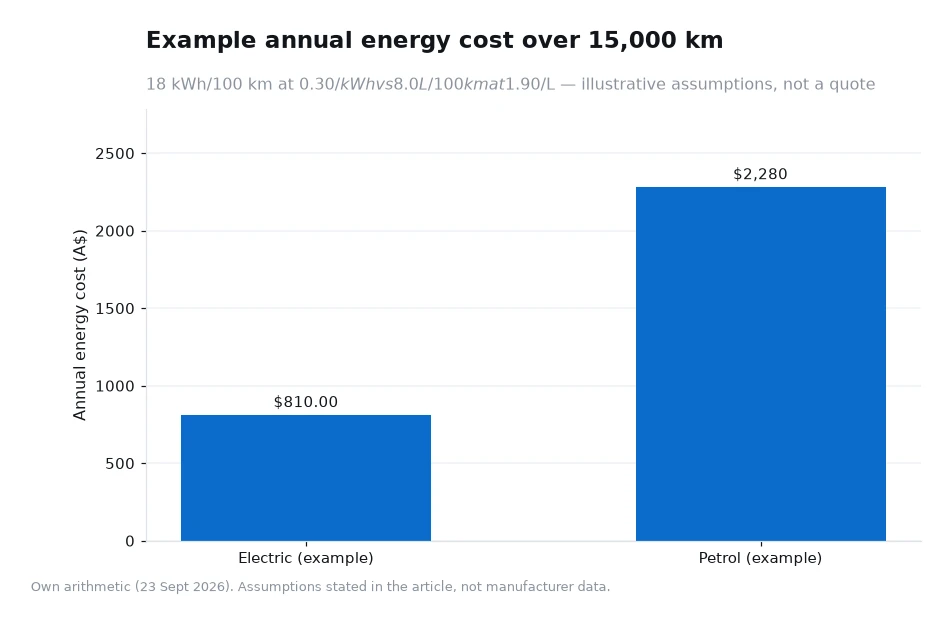
The arithmetic below is a labelled example rather than a quotation from anyone. Assumptions: 15,000 km a year, energy use of 18 kWh per 100 km, electricity at $0.30 per kWh, and a petrol comparison using 8.0 L per 100 km at $1.90 per litre. No model price appears anywhere in this article, because none is published.
Electricity first. Divide 15,000 km by 100 to get 150 blocks of 100 km. Multiply 150 blocks by 18 kWh to get 2,700 kWh for the year. Multiply 2,700 kWh by $0.30 to get $810. Then petrol. Multiply the same 150 blocks by 8.0 L to get 1,200 L, and multiply 1,200 L by $1.90 to get $2,280. The gap is $2,280 − $810 = $1,470 a year, or about $122 a month on these assumptions.
Change an assumption and the answer moves. At $0.20 per kWh the electric figure drops to $540, because 2,700 kWh × $0.20 = $540. Drive 10,000 km instead of 15,000 km and both annual figures fall by a third. That is exactly why the comparison belongs in your own spreadsheet, with your own tariff and your own odometer reading.
Frequently asked questions
Do I have to buy the car online?
No. The online step produces a price estimate only. The formal quote, the contract and the handover happen with a local dealer, and the test drive is booked through that dealer network as well.
What happens to my servicing if I move interstate?
Scheduled servicing is every 12 months or 20,000 km, whichever comes first, and it can be carried out at any XPENG Authorised Dealer, so moving does not end your coverage or reset the interval.
Where to start this week
Start with the configurator, because it is the only step that turns your preferences into a number a dealer can respond to. Save the price estimate as a PDF, note the exact variant and options, and then ring the two dealers closest to your commute and ask each for a written quote on that specification.
Book the test drive before the quote conversation finishes, so the drive and the numbers land in the same week while the details are fresh. Take a tape measure for the boot and a child seat if you use one, and check where the charge flap sits on arrival. Then compare the quotes line by line.
Specifications and ownership terms come from the manufacturer's Australian site, read 23 Sept 2026. The 15,000 km, 18 kWh per 100 km, $0.30 per kWh, 8.0 L per 100 km and $1.90 per litre inputs are illustrative assumptions for the worked example, not manufacturer data, and no model price is quoted here because none is published.[1]