Fermentation control improves when a brewery combines jacketed fermenters, glycol cooling, accurate temperature probes, pressure-rated hardware, oxygenation equipment, yeast-management tools, and gravity or pH measurement. Fermentis recommends roughly 20–24°C for many ale fermentations and 11–14°C for many lagers, while the Brewers Association lists wort aeration around 8–10 mg/L and typical pitching rates of 0.5–1.5 × 10⁶ cells/mL/°P when managing diacetyl. The equipment works best as one connected process: measure beer temperature, remove metabolic heat, verify fermentation progress, manage yeast, control pressure, and limit oxygen after fermentation.
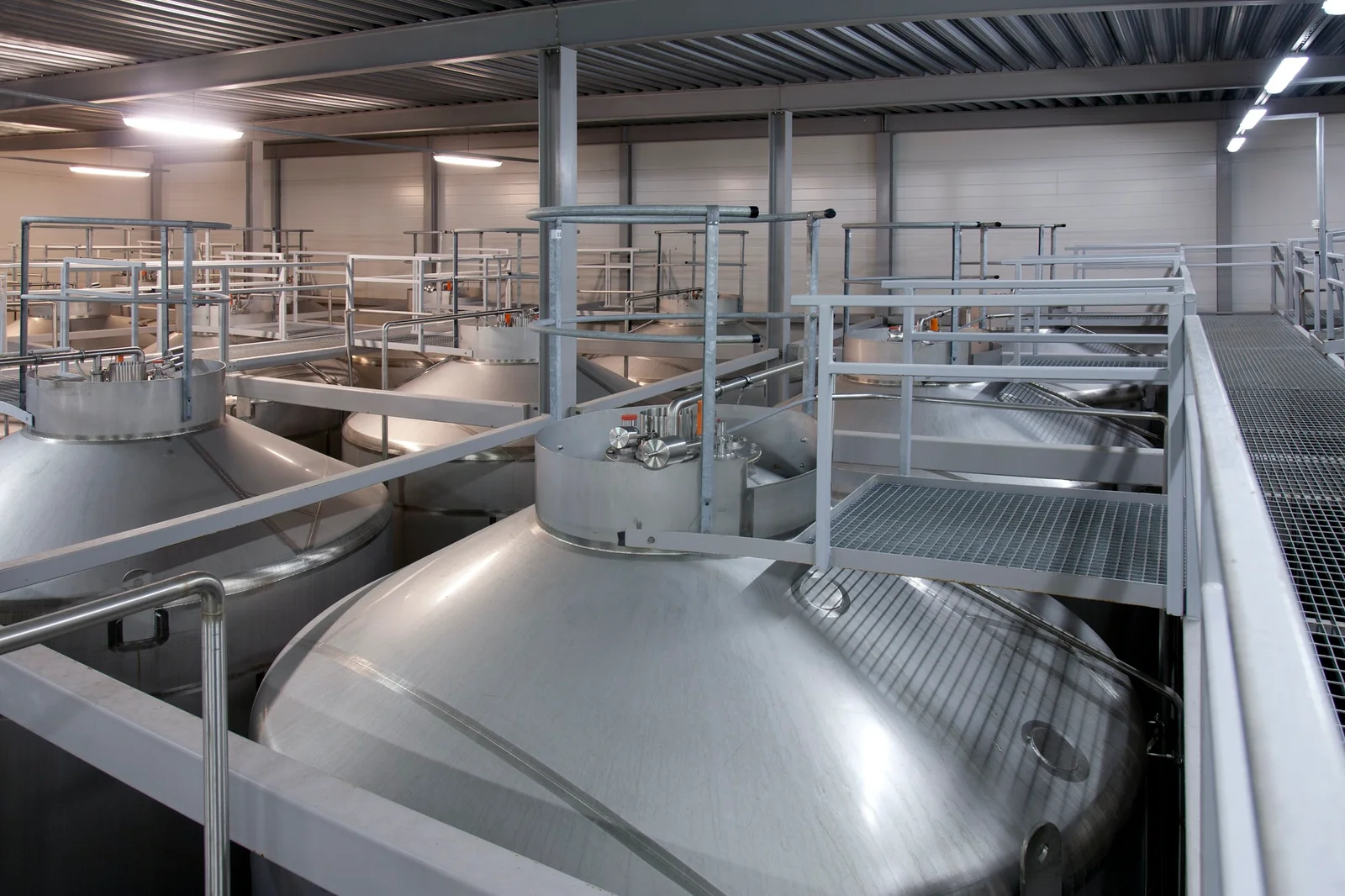
A jacketed cylindroconical fermenter gives a brewery direct control over the beer rather than relying on cellar air temperature. Fermentation releases metabolic heat, so beer inside a production tank can rise above room temperature during the most active period. Separate body and cone jackets allow cold glycol to remove that heat close to where it is being generated.
Tank selection therefore needs more than a nominal 10, 20, or 40 bbl capacity. Brewers should compare jacket area, insulation, thermowell position, cone angle, working-pressure rating, relief hardware, sanitary fittings, and clean-in-place coverage. A poorly placed temperature sensor can report a stable reading while another part of the vessel remains warmer.
Fermentis places many standard ale fermentations around 20–24°C; below 20°C, fermentation can become slower, while temperatures above 24°C can increase unwanted fermentation character for some strains. Typical lager guidance is much colder, around 11–14°C, so the same cellar may need very different cooling profiles from tank to tank.
A fermenter does not control temperature by itself. Its jacket only provides the surface through which the cooling system can remove heat.
That brings the glycol chiller into the same calculation. Chiller capacity has to cover active fermentation, cold crashing, piping losses, pump heat, ambient heat gain, and the possibility that several vessels call for cooling at the same time.
A brewery operating six fermenters may therefore need more cooling capacity than a simple six-tank multiplication suggests. One vessel may be holding at 20°C while another is being pulled from fermentation temperature toward near-cold-conditioning temperatures, creating a much larger short-term refrigeration demand.
Useful design figures include glycol supply temperature, return temperature, flow rate, pump head, pipe diameter, jacket pressure limits, and total refrigeration capacity. A system sized with only average demand may struggle during the busiest 10–20% of cellar operating hours, even though it appears adequate during normal holding conditions.
Once enough cooling is available, measurement quality determines how well it is used. A sanitary resistance temperature detector or similar sensor normally sits inside a thermowell and sends readings to a controller, which opens or closes a solenoid valve supplying glycol to the jacket.
| Equipment | Useful measurement | What the brewer can control |
|---|---|---|
| Jacketed fermenter | Beer temperature | Fermentation and cooling profile |
| Glycol system | Supply/return temperature | Heat removal rate |
| Pressure sensor | Vessel pressure | Spunding and carbonation |
| Density meter | Gravity or density | Fermentation progress |
| pH meter | pH change | Fermentation consistency |
| DO meter | mg/L or ppb oxygen | Wort aeration and oxygen pickup |
A controller with a poorly calibrated sensor can repeat the same temperature error batch after batch. Calibration checks, alarm limits, historical logs, and independent reference measurements are therefore useful even when the brewery has automated valves.
Data logging also makes timing easier to verify. Fermentis reports comparative fermentation work using lager yeast at 12°C for 48 hours before 14°C and ale yeast at 20°C, showing why a saved temperature profile is more informative than recording only the final fermentation temperature.
Temperature records become more useful when paired with gravity. A hydrometer remains practical for small operations, while digital density meters and tank-mounted instruments can produce more frequent readings without repeatedly opening a vessel.
A flat temperature curve cannot confirm that attenuation is complete. Gravity movement shows whether yeast is still consuming extract, while several stable measurements can support the brewer's assessment before cooling the tank. For comparison, the Brewers Association gives American-style wheat beer an original-gravity range of 1.036–1.056 and a final-gravity range of 1.004–1.016, illustrating how much density can change during fermentation.
Cooling too early can leave fermentation-derived compounds above the brewer's target. The Brewers Association recommends allowing enough maturation time for diacetyl reduction and describes a VDK rest after roughly 50–60% of apparent extract has been consumed, with fermentation temperature raised about 2–8°F.
Yeast management therefore belongs beside temperature and gravity control. The Brewers Association gives a broad typical pitching range of 0.5–1.5 × 10⁶ cells/mL/°P, although the appropriate rate still depends on strain, wort gravity, beer type, yeast condition, and brewery procedure.
Equipment for yeast handling may include a sanitary yeast brink, propagation vessel, sample valve, microscope, hemocytometer, or automated cell counter. Cell concentration and viability measurements provide more information than simply transferring a fixed volume of slurry from one batch to another.
Dry yeast specifications also show why microbiological quality matters. Fermentis lists viable yeast above 1 × 10¹⁰ CFU/g and purity above 99.9% for several commercial strains, while opened product is specified for refrigerated storage at 4°C and use within 7 days.
Healthy yeast also depends on wort conditions before fermentation starts. Brewers Association guidance for diacetyl management lists roughly 100–140 mg/L free amino nitrogen for normal-gravity wort and approximately 8–10 mg/L wort oxygen from sterile air or pure oxygen.
That makes a sanitary oxygenation assembly, flow control, diffusion stone, and dissolved-oxygen meter useful additions for breweries seeking repeatable starts. Measuring dissolved oxygen is more reliable than assuming that a fixed gas pressure or oxygenation time produces the same result in every wort.
After fermentation begins, oxygen management moves in the opposite direction. Cellar procedures usually aim to reduce unnecessary air contact during transfer, maturation, filtration, and packaging. Closed hoses, purged receiving vessels, pressure-capable tanks, sanitary valves, and low-oxygen transfer methods help preserve the beer produced in the fermenter.
Pressure-rated equipment adds another control point. Spunding valves allow carbon dioxide to leave the vessel above a set pressure rather than allowing pressure to increase without regulation, and suitable fermenters can retain part of the naturally produced CO₂.
Pressure settings should stay within the vessel manufacturer's allowable working pressure and must be backed by properly sized relief equipment. A pressure gauge, calibrated regulator, relief valve, and operating procedure all need to agree; fermentation vessels should never be treated as pressure vessels unless they were built and rated for that service.
Pressure can also change yeast performance, so temperature, fermentation stage, strain, and pressure should be reviewed together rather than adjusted independently. Breweries purchasing Turn-Key brewery solutions can therefore benefit from specifying fermentation vessels, glycol distribution, pressure hardware, sensors, and cellar controls as one integrated package instead of matching them after installation.
Sanitation then becomes the condition that allows all those measurements to remain useful. Temperature control cannot correct contamination from an inadequately cleaned sample port, valve, gasket, transfer hose, or tank surface.
A clean-in-place system should provide suitable chemical concentration, contact time, temperature, mechanical coverage, and circulation. Spray devices need to reach the internal surfaces reliably, while removable parts still require inspection because shadows around fittings or damaged seals can reduce cleaning performance.
Fermentis specifications for several dry brewing yeasts state total bacteria below 5 CFU per 10⁷ yeast cells and individual limits below 1 CFU per 10⁷ cells for organisms including Pediococcus and acetic-acid bacteria. Production tanks should be managed with similarly disciplined attention to sanitary handling because introduced microorganisms can alter acidity, attenuation, aroma, and package stability.
pH measurement gives another inexpensive reference point. A calibrated brewery pH meter can show whether a batch is following its usual pattern when readings are compared at the same process stages, although pH alone cannot identify the cause of an abnormal fermentation.
The strongest cellar record combines temperature, gravity, pH, yeast generation, pitching amount, oxygenation, pressure, and elapsed time. A brewery running 20 fermenters can then compare tanks using measured records instead of relying on operator memory, especially when several beer styles are fermenting under different schedules.
Automation becomes practical as that tank count grows. A central panel can record temperature, open glycol valves, display tank status, generate alarms, and store profiles, while operators still verify samples and sensory quality before changing process stages.
Automation should therefore repeat defined operating limits rather than replace brewing measurements. Fermentis notes that its commercial yeast comparisons use controlled conditions such as 12°C followed by 14°C for lager strains and 20°C for ale strains; repeatable equipment lets a production brewery apply the same principle at commercial scale while adjusting the profile for its own yeast, wort, and beer specification.